Insights
The Case for Smaller, Smarter Pickleball Facilities
Bob Lorincz · Co-Founder, Pickleball 365 ·
When Deanna and I first started talking seriously about opening an indoor pickleball facility, we spent a lot of time looking at what was already out there. Like everyone else, we were impressed by the big facilities. 10 courts. 15 courts. Sometimes more than 20. Large spaces with lounges, restaurants and entertainment built around the game.
There is a place for that model. But the more we studied it, the more I came back to a simple question. Did we really need to build something that big to create a great pickleball experience? For us, the answer was a hard no.
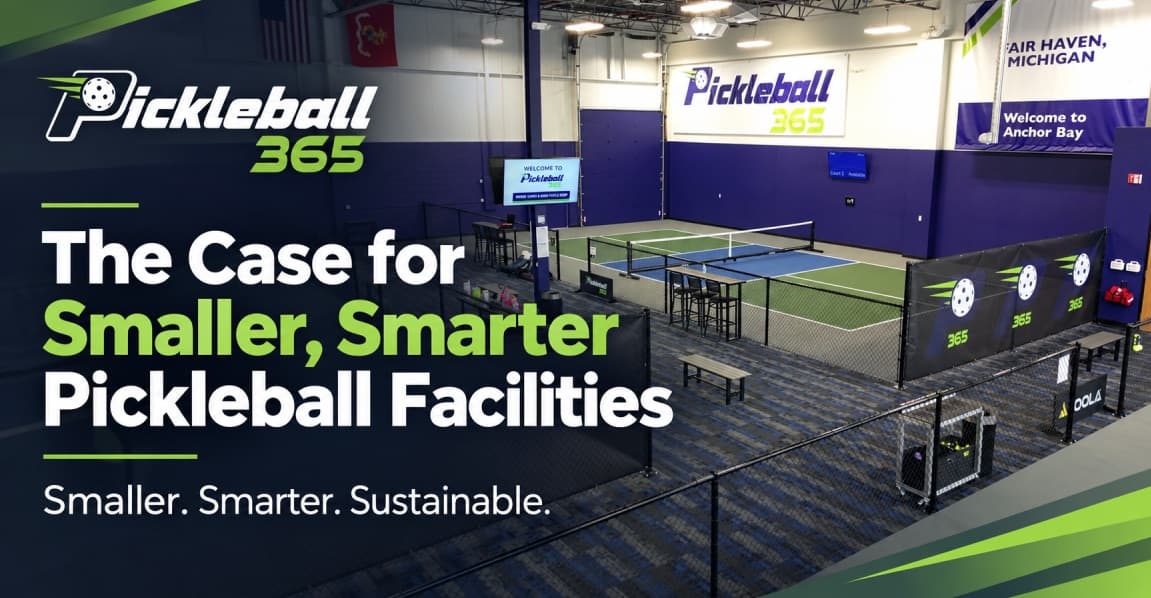
We were more interested in creating a facility people would use consistently, not only for an occasional outing. We wanted excellent courts, professional lighting, useful technology, easy access and a strong sense of community. We also wanted the business to make sense financially and operationally. That thinking led us to three courts in Fair Haven, Michigan.
Operating the facility has taught us that smaller does not have to mean limited. In many ways, it creates more discipline. When you have only a few courts, you pay close attention to how each one is being used. You notice the quieter hours. You learn what players want at 5:00 in the morning, 10:30 on a weekday and 8:00 at night. You start thinking less about total court count and more about how productive each court can be.
That lesson feels especially relevant now. The indoor pickleball industry is going through a reality check. Some large facilities are entering bankruptcy, closing, or being offered for sale at steep discounts. High build costs, large leases, heavy staffing requirements and debt service leave little room for mistakes. That does not mean the sport is losing momentum or that large facilities cannot succeed. It means enthusiasm for pickleball and the economics of operating a pickleball business are two different things.
Our experience has reinforced our belief that there is another path. A facility with three to five courts can support memberships, private reservations, open play, leagues, clinics, lessons, tournaments, youth programs and community events. With the right technology, it can also give players access around the clock without building a traditional front desk operation around every hour the doors are open.
The right size will always depend on the market, the real estate and the operating plan. I am not interested in arguing that smaller is automatically better. I am interested in asking whether every square foot has a clear purpose and whether the surrounding community can realistically support the capacity being built.
For us, three courts created the right balance. We had enough space to build a real pickleball community, a small enough footprint to stay focused on utilization and efficiency and a model that could fit into more communities.
I believe the next phase of indoor pickleball will be less about who can build the largest facility and more about who can build a sustainable one. That is the conversation I want to help lead.
If you’re exploring indoor pickleball ownership, I’d invite you to take a closer look at why we built Pickleball 365 around a smaller, smarter three-to-five-court model and how that discipline shapes the franchise opportunity.